Saturday, January 13, 2007

Monday, January 08, 2007

Don't trade the news?

"news is exellent stuff to trade , before I was mentored by the “Monkeyman “ I was always taught don’t trade the news , but the Monkeyman said whaaaaat ? ??? he will take a break and say Bruce I will be back at a time for the news , he takes breaks but wants to be at the screens for the news to trade it IF there is opportunity "

Saturday, January 06, 2007

The Safeguards

To operate effectively in the trading environment, we need rules and
boundaries to guide our behavior. It is a simple fact of trading that
the potential exists to do enormous damage to ourselves—damage
that can be way out of proportion to what we may think is possible.
There are many kinds of trades in which the risk of loss is unlimited.
To prevent the possibility of exposing ourselves to damage, we need
to create an internal structure in the form of specialized mental discipline
and a perspective that guides our behavior so that we alwaysact in our own best interests.

Sunday, December 31, 2006

Mike Davis says:

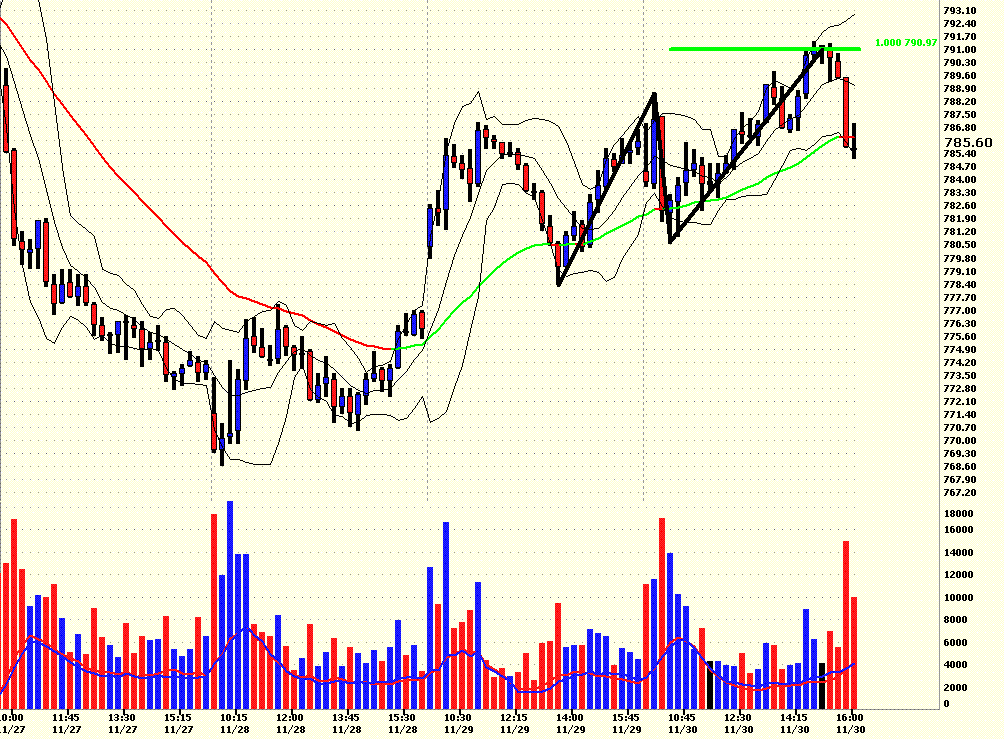
For most of us, this is the eternal struggle trying to define a reversal or correction. You get some help with the rule of alternation as quite often, if 2 is simple, 4 is complex or visa versa. At least that is what a lot of the wave people think.
The Measured moves happen a lot but as you point out, differ in outcomes. The only thing that might help you realize what is happening in the first wave down is the count and pattern of the previous move up.
With the waves, there is always an alternate count lurking around. I try not to get too stuck on the wave counts and hope that the win/loss percentage helps pick it up.

Wednesday, December 20, 2006

As long as you are susceptible to the lands of errors that are the

result of rationalizing, justifying, hesitating, hoping, and jumping the

gun, you will not be able to trust yourself. If you can't trust yourself to

be objective and to always act in your own best interests, achieving

consistent results will be next to impossible. Trying to do something

that looks so simple may well be the most exasperating thing you will

ever attempt to do. The irony is that, when you have the appropriate

attitude, when you have acquired a "trader s mind-set" and can remain

confident in the face of constant uncertainty, trading will be as easy

and simple as you probably thought it was when you first started out.

Saturday, December 16, 2006

Plangcha and his attitude

I stumbled into trading and loved it like no other buisness I had been involved with before , I have got out of all other buisness I was involved in and am completely focused on trading , I absoloutly love it , its pure trading without all the clutter associated with all other buisness , I rarely wear a suit even more rarely a tie and never have , it used to raise a smile at meetings in the past but now well I can sit at the screens naked if I feel like it and the market doesn’t care a lot, smooshing engratiating myself with customers etc which I always hated with a passion is worthless in trading , if anyone asks how I do something I can be honest straight out and it doesn’t matter wether they like it or not , I don’t have to use energy candy coating anything , the ONLY think that matters is consistantly picking the right trades .

Sunday, December 10, 2006

Saturday, December 02, 2006


Confidence and fear are contradictory states of mind that both

stem from our beliefs and attitudes. To be confident, functioning in

an environment where you can easily lose more than you intend to

risk, requires absolute trust in yourself. However, you won't be able

to achieve that trust until you have trained your mind to override

your natural inclination to think in ways that are counterproductive

to being a consistently successful trader. Learning how to analyze the

market's behavior is simply not the appropriate training.

Sunday, November 26, 2006


When you operate from the assumption that more or better

analysis will create consistency, you will be driven to gather as many

market variables as possible into your arsenal of trading tools. But

what happens then? You are still disappointed and betrayed by the

markets, time and again, because of something you didn't see or give

enough consideration to. It will feel like you can't trust the markets;

but the reality is, you can't trust yourself.


Monday, November 20, 2006

We need technique to

achieve consistency. But what technique? This is truly one of the

most perplexing aspects of learning how to trade effectively. If we

aren't aware of, or don't understand, how our beliefs and attitudes

affect our perception of market information, it will seem as if it is the

market's behavior that is causing the lack of consistency. As a result,

it would stand to reason that the best way to avoid losses and become

consistent would be to learn more about the markets.